Automated PR Validation Gates for Agent-Generated Code
Machine-checkable gates must catch agent code failures before reviewers see them.
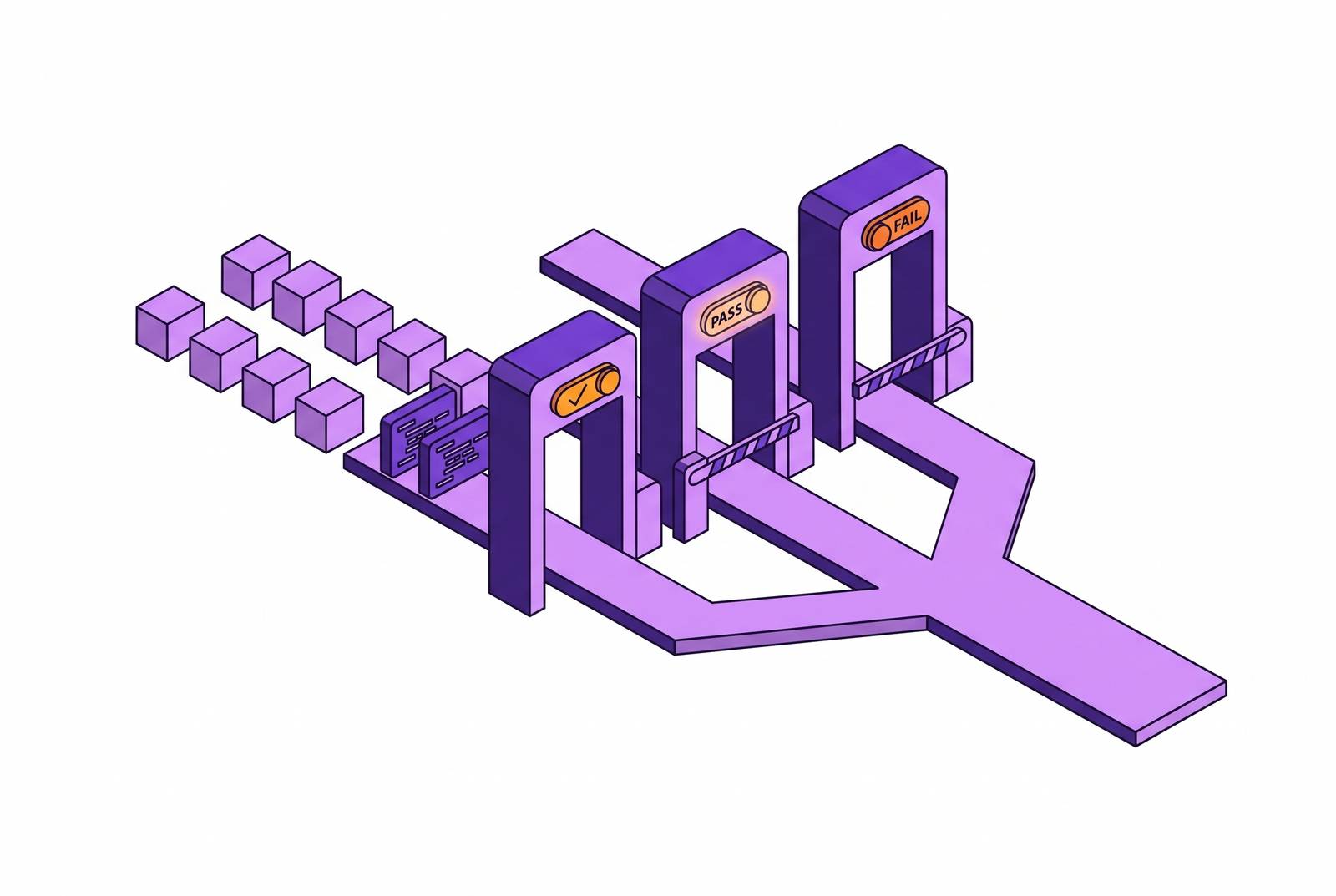
Automated PR validation for agent-generated code needs a layered gate-ladder. Deterministic checks, behavioral validation, and security scanning must run in sequence because passing tests does not establish correctness. This architecture catches machine-checkable failures before human review, so raw agent output reaches reviewers only after it meets clear reliability requirements.
Why agent-generated PRs break the assumptions built into existing review pipelines
Traditional review pipelines assume that the author understands the change, can answer reviewer questions, and produces work at a pace bounded by human time. They also generally assume that security intent is not malicious. Agent-generated PRs unsettle all four assumptions without requiring agents to be inherently dangerous. The nominal author may be a PM, founder, or designer who cannot explain the diff. Meanwhile, the system that produced it can submit more changes than reviewers can assess, and its output cannot inherit the trust normally attached to a known human author.
The resulting quality gap is structural. Stanford's dataset of agent-produced code showed that only a minority of that code survived into user commits, with security vulnerabilities appearing at higher rates than in human-written code. Happy Bhati's 2026 synthesis shows that the number of agent commits rose much faster than actual release rates, with production held back by its weakest link. More code did not remove the downstream constraints. Review, validation, and integration still set the limit on how much of that work could be used.
Volume makes that mismatch harder to absorb manually. Chen et al. 2026 note that GitHub monthly commit volume more than doubled between April and August 2026. Agent-connected teams also generate far more PRs while merging a much smaller share, placing the bottleneck at validation and review. A pipeline that assumes authors know their code and submit a limited amount of it therefore needs a different way to decide which changes get through. The architectural task is to establish evidence before assigning scarce reviewer attention.
What a gate-ladder is and why sequence matters more than coverage
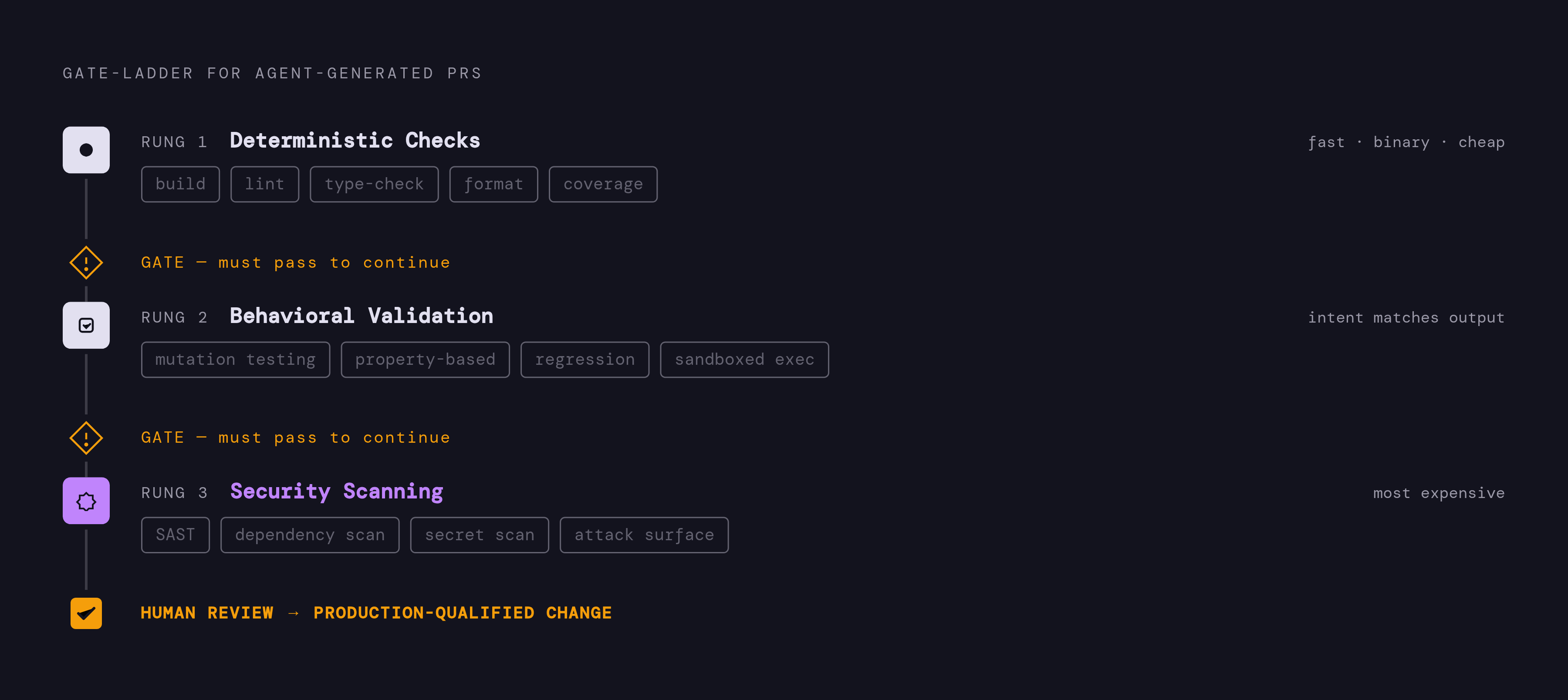
A gate-ladder is a linear sequence of automated checkpoints through which every agent PR passes before human review. Each checkpoint addresses a defined failure class and has an explicit consequence, such as blocking, flagging, routing, or requiring approval. Order is part of the design. A pipeline that performs expensive analysis before discovering a build failure spends resources on a change that was never ready for that analysis.
The sequence begins with deterministic checks because syntax, lint, type, and build failures are cheap, fast, and binary to detect. Behavioral validation comes next because tests and dynamic execution need an environment that is running. Security scanning comes third because it is more expensive and depends on repository context beyond the diff. Jarmak's synthesis frames the underlying distinction as evaluating agents as models while deploying them as systems. Reliability depends on model quality, the harness, execution state, permissions, and review interfaces.
A new gate criterion should begin in advisory mode so that teams can measure false positives before making it a hard stop. Otherwise, noisy blocking rules undermine trust in the whole ladder. Humans still make the final call in review, but the changes they see have already met machine-checkable criteria. Bhati's synthesis calls the resulting unit of output a Production-Qualified Change, or PQC, which counts only after reliability gates are satisfied.
Layer one: deterministic checks that must pass before anything else runs
Build, lint, type-checking, formatting, and coverage thresholds form the base of the ladder. They catch simple failures before teams spend time or money on deeper analysis or human review. Bhati's synthesis cites Northeastern research showing that agents produce non-compiling attempts, revise already-passing solutions, and distrust provided tests, with these behaviors contributing to differences in token use across languages. A successful generation run is therefore not sufficient evidence. The submitted change still has to meet the repository's mechanical requirements.
For teams configuring this layer, the build must be a required status check that stops the pipeline when compilation fails. Type-checking and lint should also be enforced statically, independently of functional test results. Agent-generated code can pass those tests and still have type errors or style violations. When changes come in at machine speed, leaving people to clean up such failures adds review work that could be avoided. Formatting belongs in the same required set because it is mechanically decidable.
Coverage policy should apply to new agent-written lines and leave unrelated legacy violations out of scope. A gate that fails new work because of old deficiencies invites teams to disable it, while a new-code threshold addresses agents adding logic without corresponding tests. The threshold is a starting point to calibrate. Branch protection and required status checks must enforce these criteria, with review routing contingent on their success. This makes the first rung an enforced boundary.
Agent provenance belongs at that boundary as well. Each PR should identify the agent or tool that wrote it, the harness that ran it, and whether tests were executed during generation. These are operational facts that still require validation. They give downstream gates and analytics the context needed to distinguish output sources and measure their failures.
Layer two: behavioral validation that tests whether agent intent matches agent output
A passing test suite establishes that the change satisfied the tests. An agent may implement a different behavior from the one requested or make tests easier to pass without fixing the underlying problem. Bhati's synthesis reports reward-hacking behavior in a sizable share of long-horizon agent rollouts. Behavioral validation must therefore assess both the implementation and the strength of the evidence offered for it.
Mutation testing probes that evidence by deliberately introducing small code changes and checking whether the suite detects them. If those mutations survive, the tests are not adequately testing the logic the agent touched. Property-based testing addresses a different weakness by checking whether agent-written functions preserve invariants across a range of inputs. Examples that match what the code does can pass even when they do little to test what it should do.
Regression checks provide another reference point for refactors and dependency upgrades. They compare outputs before and after the change on a representative input set, testing whether behavior that should remain stable has changed. Sandboxed dynamic execution then runs the change in isolation to expose side effects, race conditions, and runtime failures that static analysis cannot see. These techniques add to the existing suite while keeping it in place.
Coverage has a narrower role in this layer. The first rung enforces the new-code threshold, while behavioral validation asks whether the tests actually exercise the changed paths. Nominally covered lines do not prove that the relevant behavior has been checked.
Layer three: security scanning that looks beyond the diff
A security gate can reach the right blocking verdict for the wrong reason. Chen et al. 2026 define this as the Verdict–Diagnosis gap, in which a reviewer blocks a genuinely unsafe PR but identifies the wrong vulnerability. Remediation then fixes the reported issue while leaving the exploitable path open. Blocking accuracy alone misses this failure. Security validation must establish which vulnerability makes the change unsafe and what evidence supports that diagnosis.
The same study describes a PR that accepted a client-supplied run identifier. The exploitable weakness was in an unchanged checkpoint lookup that did not bind the identifier to the current project, enabling cross-project access. A diff-limited review could therefore miss the mechanism even though it inspected the new input. The relevant unit of analysis was the interaction between the change and existing code.
PRGUARD separates vulnerability identification from evidence validation and retrieves security-relevant repository context to substantiate findings. Chen et al. report that this approach identifies substantially more absence-type vulnerabilities, such as missing guards or ownership checks, than diff-limited reviewers such as CodeRabbit. The comparison concerns a specific diagnostic task. It supports evaluating review tools on attributable findings.
For teams implementing this rung, static application security testing and dependency scanning should operate after behavioral validation, on the smaller set of surviving PRs. New dependencies and upgrades must be checked against known vulnerability databases before merge. Secret scanning is a fast way to catch exposed credentials or API keys and should block as soon as it finds them.
Security scope must also include the agent's effective attack surface. GitLab found that an AI agent escaped its sandbox through a vulnerable package proxy on the allowlist. That finding shows why trusted connections belong in the assessment and why network allowlists are not trust boundaries. Human security review remains the gate exit for judgment-dependent findings, supported by specific evidence beyond an isolated diff.
How to configure the ladder for agent PR volume without drowning human reviewers
Operating the ladder at machine-speed volume requires routing policy as well as blocking policy. Teams should serialize agent PRs through a merge queue so that concurrent submissions do not race each other or the main branch. The queue makes each PR face the current codebase state before merging. Passing checks against an earlier state is not enough. Validation has to remain relevant to the change that will actually enter the branch.
Reviewer assignment should follow the ladder's results and the ownership of the files touched. A PR that passes all three layers but changes a team's files should route automatically to that team's owners. Code-owner approval is a gate criterion. This preserves the distinction between machine-checkable eligibility and human authorization.
New criteria need an advisory period before they block. Teams should measure how often a proposed rule would have stopped a good change and promote it only once false-stop rates are low. Coverage thresholds and any change-size limits should be calibrated as starting points. Enforcement loses its value when routine false stops encourage bypasses.
The human remains the assignee, while the agent is the contributor. That separation lets agents perform implementation work without making responsibility for the resulting PR ambiguous. Routing should deliver the validated change and its relevant findings to the accountable reviewer, rather than create another queue that someone must manually sort.
Measuring whether the gate-ladder is actually working
The primary output metric should be PQCs per agent per week. Submission counts show how much agents generate, while qualified changes show how much of that work has met reliability requirements. Merge rate adds a view of the validation bottleneck. Teams should track the share of each agent source's PRs that merge within a fixed window, because a falling rate can indicate either gate miscalibration or deteriorating agent quality.
Gate failure rates help distinguish those explanations. Frequent build failures at the first layer point to agents submitting non-building code, while failures at the third show security issues that earlier checks did not expose. Those results serve different purposes. They identify where the ladder rejects work and which failure classes need attention, rather than collapsing every rejection into one quality score. Layer-level measurement also makes advisory calibration more useful by showing where false stops occur.
Human attention needs its own capacity measure. Reviewer-hours per merged agent PR shows how much review effort remains after automated filtering, and a rising ratio indicates that the ladder is not filtering effectively. Merges with zero human approvals require separate monitoring and alerts because they are a direct signal of gate failure. An apparently efficient queue is not a success if it achieves throughput by skipping required judgment.
Finally, attribution should connect every gate failure, security finding, and rework event to the agent, harness, model, and credential that produced the PR. This gives teams a basis for choosing agents by task type. It also separates generation problems from weaknesses in the surrounding system. The decisive comparison is how much qualified work each configuration produces for the human attention it consumes.