The Staffing Model That Lets One Platform Engineer Support Hundreds of Parallel Agent Runs
One engineer can run hundreds of agents by dispatching, governing, and reviewing.
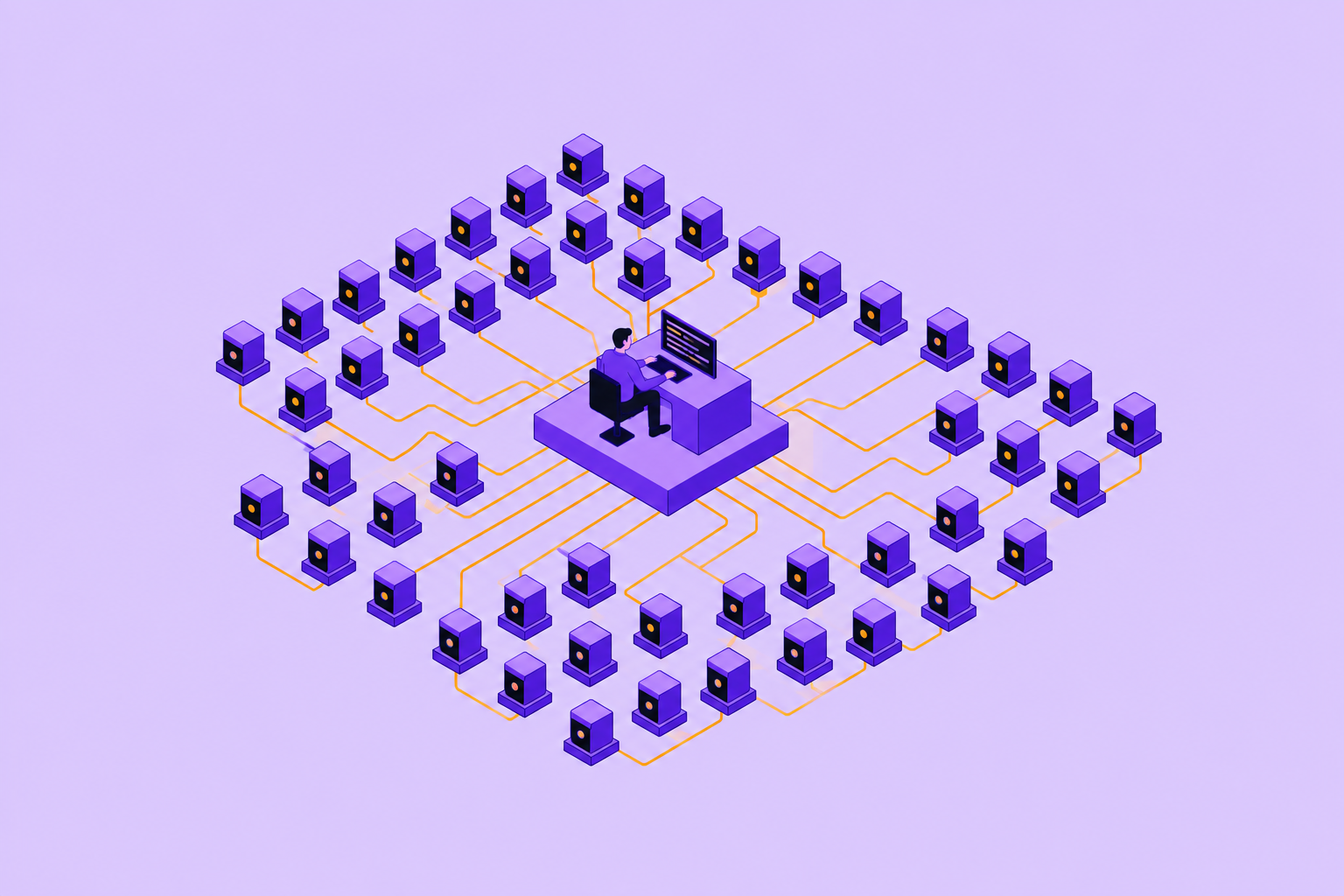
A multi-harness cloud coding agent platform lets a team run agents in parallel without having to manage the infrastructure for each session. The staffing model is one platform engineer dispatching independent tasks, governing isolated environments, and reviewing pull requests. Supporting hundreds of parallel runs depends on that operating model.
Why the 1-to-hundreds ratio is now an engineering problem, not a research question
The shift in 2026 is from “will the agent finish? to “who runs the fleet?”. Agent capability is no longer the only constraint. Agents are reliable enough for one engineer to keep dozens busy if that engineer stops treating each session as an interactive coding exercise. The staffing implication is a change in the level at which the engineer works, from producing individual changes to operating the system that produces them.
Coinbase CEO Brian Armstrong describes a large fleet of full-time AI agents inside the company, with engineering teams that once needed ten people now running with two to four. Ramp’s Inspect accounts for a large majority of pull requests merged to its frontend and backend repositories, including output from non-engineers, with a million sessions run to date. These are operating examples. They shift the question toward how work enters the fleet and how its output earns approval.
Those examples do not establish a universal staffing ratio. The practical limit is the supply of independent, well-scoped tasks and the review bandwidth available to judge their results. Starting hundreds of VMs does not solve either problem. A 1-to-hundreds model is therefore conditional on an engineer being able to dispatch work without supervising every run and assess output without reconstructing every session.
What the fleet operator role actually replaces and what it does not
The fleet operator is an operating-layer engineer. The role’s output is a stream of reviewable pull requests. Its three responsibilities are dispatching tasks to isolated sessions, governing those sessions’ environments, and reviewing the resulting changes. These responsibilities form one job because decisions at each stage constrain the next.
The role replaces continuous participation in execution while retaining engineering judgment. The engineer’s freedom to step away from the keyboard while agents work is fundamental to the staffing model. If every session requires a human to steer it, increasing concurrency also increases the demand for human attention, leaving the engineer at the same level of abstraction as before.
Foreground and background work can still coexist. Experienced practitioners actively steer a small number of foreground agents on complex, high-stakes work while most of the fleet runs as background jobs. Those jobs demand attention when a pull request is ready or a check fails. The useful analogy is gardening, with the operator scoping work, assessing what comes back, and deciding what can stay.
How engineers dispatch Claude Code or Codex from Slack and get a pull request
Dispatch begins with decomposition. Independent tasks can run concurrently, while tasks that touch overlapping files belong in sequence. Each task needs its own workspace, whether a git worktree or a dedicated cloud VM, so agents cannot overwrite one another’s work. The trigger surface then becomes the operator’s primary interface, routing those tasks from the systems where their context already lives.
Linear Agent supports cloud coding sessions using Claude Code or Codex, started through issue assignment or a request in a chat, comment, or Slack thread. More broadly, Slack @agent mentions can trigger incident triage and ad-hoc investigations that return a thread reply and a draft PR link. Teams assign GitHub issues to send agents scoped features and bug fixes, and assign Linear tickets to send them well-specified work. Engineers need not move every request into a separate coordination system before an agent can begin.
Coinbase built Forge on Linear’s Agent SDK to work across Slack, GitHub, and Linear with the context already in each system. Coinbase describes Linear as the place agents go to get their bearings before starting a task. Linear’s own triage automation gathers evidence from Sentry or Datadog through MCP and inspects the codebase to trace the root cause. Linear uses that workflow internally to resolve a meaningful share of incoming bug reports on the first pass.
Dispatch also extends beyond requests made by a person. Alerts, CI webhooks, and schedules can initiate flaky-test detection, regression isolation, dependency bumps, and nightly triage without someone at the keyboard. Orchestrator closes the return path by routing failed checks and review comments back to the agent responsible for the branch. This makes dispatch a continuing workflow rather than a one-time handoff followed by manual repair.
Governing the environment through isolation, credentials, and access
Isolation is the first governance decision because parallel agents need separate branches and working directories. Without that boundary, they can overwrite changes and leave the working directory in an indeterminate state. The reviewer then has no stable version of the work to judge. Git worktrees provide the cheapest isolation that preserves a normal Git workflow, with multiple directories sharing one repository and each agent working on its own branch.
Dedicated cloud VMs provide a different execution boundary. Each session runs in an isolated Linux environment spun up for the task and torn down when the PR is opened. There is no shared session state or laptop dependency, and sessions survive sleep and restart. A worktree separates changes, while a dedicated VM also separates the environment in which the agent executes.
The operator must decide on credentials separately because workspace isolation alone does not set permissions. Agents running on developer laptops get the developer’s credentials and access, which causes problems with audits and blast radius. Cloud-hosted environments with scoped credentials let the operator control what an agent can reach, audit what it did, and revoke access at the environment level. Access no longer has to be governed through the individual developer.
Enterprise operation adds requirements that must be enforceable without a services engagement. These include SOC 2 Type II, SAML SSO and SCIM provisioning, audit logs, seat management, policy enforcement, clear training-data policies with an option to exclude code, and VPC or self-hosted deployment options. Harness portability is another governance requirement. A vendor’s changes to pricing, capability, or policy should not force a new operating model. A stable environment lets the team change harnesses and keep the same review gate.
Reviewing pull requests as the fleet operator's primary output gate
Review costs grow as agents produce more work in parallel unless the tasks sent to them yield independent, PR-sized changesets. The sustainable review unit is a task. Each task lives in its own worktree, produces an independent diff, and can be reviewed, merged, or discarded separately. This is where decomposition pays off, because the reviewer can judge one bounded change without untangling several agents’ overlapping work.
Ramp’s Review Buddy understands the codebase, reviews changes for quality and security, sends them to the right human reviewer, and handles most pull requests automatically. Ramp’s on-call assistant OCA assisted with a large share of incident-fix pull requests over a four-week window, with responders consistently rating it helpful. In these cases, agents do much of the preparation and triage, while people still need to use their judgment.
Failures must also return to the right session. Orchestrator sends failed-check logs to the agent that owns the branch and returns review comments to the same session thread by thread. It does not hand the PR to a person until checks pass. The reviewer can let the agent act without having to move logs between systems and explain feedback again.
The unit of completed agent work is a reviewable pull request. A human can merge it, comment on it, or send it back. That output gate preserves engineering accountability even when the engineer did not write the change.
What the infrastructure layer must provide for the ratio to hold
The platform must make the three human responsibilities sustainable. Five properties define that requirement, namely per-session isolation, cloud execution, event-driven triggers, closed feedback loops, and harness portability. None is a substitute for the others. Isolation prevents collisions, but it cannot remove the operator’s dispatch burden or route a failed check back to its owner.
Cloud execution separates the fleet’s working hours from the engineer’s laptop. Sessions keep running without consuming local resources or depending on local credentials, while event-driven triggers accept work from Slack, GitHub, Linear, CI webhooks, and schedules. Closed feedback loops remove another manual dependency. If checks and comments are not routed automatically, the operator must arrange every repair, which makes it hard to run more than a handful of agents.
A genuinely multi-harness platform supports agent harnesses such as Claude Code, Codex, Cursor, and OpenCode without forcing the team to change its operating model when switching. The harness is the interchangeable execution component. The environment is the product, because it supplies the isolation, access boundaries, triggers, and feedback paths on which the staffing model depends.
Pricing must also fit the way a fleet runs. Seat-based or token-based charging can make costs unpredictable at scale, while compute-based pricing aligns charges with actual utilization. Under that model, a workspace incurs charges only while active and nothing while it sleeps.
How teams make the transition from individual agent use to fleet operation
Teams start with people using agents on their own, move to background agents on scoped tasks, add scheduled and event-driven automation, and then run a full fleet. Each stage changes how much execution happens without a person present. It also gives the team a chance to develop the task-scoping skill needed for the next stage.
Foreground use begins with one to three sessions that the engineer actively steers. This is where trust in a harness develops and the engineer learns which tasks can be separated cleanly. Background work then introduces dependency bumps, isolated bug fixes, and test coverage gaps that run while the engineer does something else. The return value is a PR for review. At that point, the engineer begins operating a queue of outcomes.
Scheduled and event-driven automation removes the need to initiate each run manually. CI failures, Linear tickets, Sentry alerts, and Slack mentions can start sessions, shifting the operator’s attention toward permissions and output. Teams should connect agents to Slack, Linear, and GitHub, where work already lives, rather than build a parallel coordination system from scratch. That route gets teams to fleet operation faster without requiring a new workflow for every participant.
Decomposition remains the hardest and most important skill. Tasks that compete over the same files cannot safely run in parallel, regardless of how much compute is available. The number of agents one engineer can sustain depends on the ability to create non-overlapping, PR-sized units and preserve enough attention to review them. For engineering leaders, the opportunity is expansion, with more output per engineer at the same staffing level.