One VM per Task Is the Only Isolation Model That Scales for Parallel Coding Agents
Worktrees split code, but only VMs split the runtime agents share.
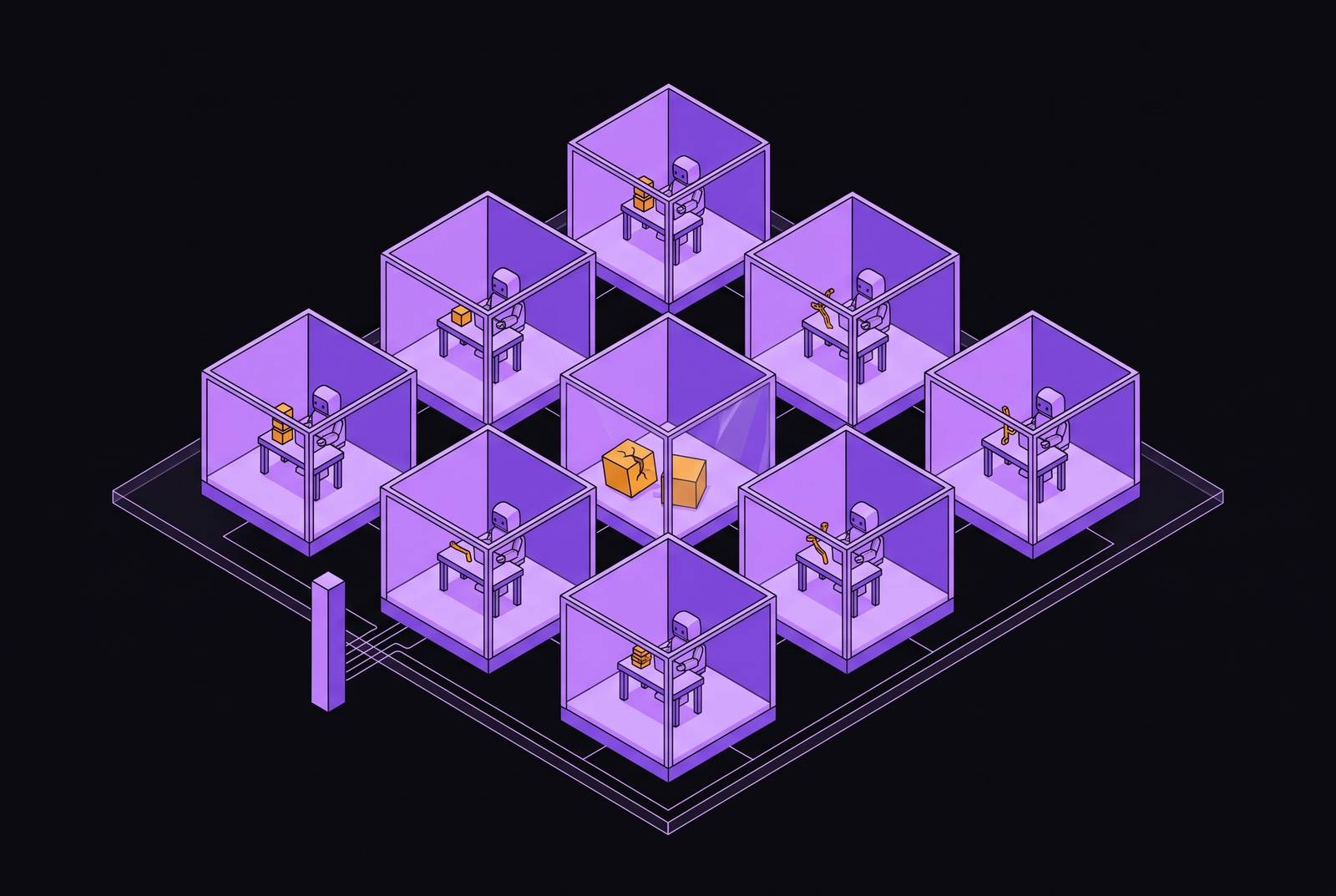
A multi-harness cloud coding agent platform needs one VM per task so it can run more tasks in parallel without failures caused by a shared environment. Worktrees separate code, while dedicated virtual machines separate the runtime in which agents install dependencies, start services, and run tests. The architectural requirement is a dedicated, fully configured, observable environment for every task, regardless of which harness executes it.
Why parallel coding agents expose shared environments as a structural problem
A handful of coding tools now decompose work into simultaneous sub-agents, each with its own context window and tool access, while most of the field still runs one synchronous loop. Google Antigravity 2.0 spawned 93 sub-agents in parallel in a public demo of live fan-out. An environment built for one active worker must now let many workers run on their own without getting in each other’s way.
The economic pressure reinforces that architectural change. Parallel agents consume model tokens and compute environments simultaneously, so usage can grow much faster than engineering headcount. More concurrent tasks therefore mean more independent activity against the infrastructure. Isolation becomes a central engineering requirement. What was an occasional inconvenience for a single agent becomes a structural weakness when several agents can change the environment at once.
What actually breaks when multiple agents share an environment
The conflicts occur at the layers agents actually touch, including the filesystem, process table, dependency cache, and network stack. When two agents edit the same checkout, they can overwrite changes the other has yet to finish. Even when their intended code changes are unrelated, the agents can still depend on the same mutable environment to complete them. Code ownership alone cannot prevent that interference.
When agents install different package versions, they can corrupt a shared cache, so the next agents start with broken state. Services create another point of contention when two agents try to bind the same development server port. Processes can also outlive their original task. A background process left behind by one agent may consume resources or corrupt state for the next agent using that host, so a completed assignment does not necessarily end its effects.
Glite ARF’s campaign audit shows how failures build on each other in research across 273 tracked tasks run by up to twelve parallel agents. It found train-data corruption in dozens of feature sets as well as target-variable leakage. This research evidence shows the same dependence on rules around mutable state found in production engineering teams. The framework reports that, after thousands of agent invocations, failures to follow prompt-encoded rules remain in the low single digits. Over a campaign that runs for weeks, those lapses add up to dozens of broken artifacts. Asking agents to respect a boundary is not equivalent to enforcing one.
Why git worktrees reduce file collisions but leave the deeper problem untouched
Git worktrees meaningfully improve parallel coding by giving each agent its own checked-out branch. That eliminates the most visible collision between concurrent workers, namely overwriting each other’s changes in a common checkout. Agents can work on their own implementations without having to coordinate every file edit. For tasks that interact only within those checkouts, this gives them a way to keep their work apart.
The guarantee stops at the runtime boundary. Agents that use worktrees still share the host’s kernel, process table, package cache layout, and network identity. When agents install packages or start services, they act outside the boundary that the worktree provides. Ports, databases, and external services remain shared unless separately configured. A branch boundary cannot assign a service its own port or give a task a separate database.
Empirical work on coding agents with worktree isolation reports genuine parallel speedup across model variants. That benefit does not establish complete environmental independence. The same research literature notes that speedup disappears or degrades when agents need to run services, install packages, or touch shared state. Coordination scripts and locks can control those interactions, but each one has to handle another resource that the agents share. Worktrees solve file collisions, while the surrounding patches manage the runtime conflicts that remain.
What a VM boundary actually guarantees that worktrees and containers do not
A hardware-virtualized VM moves the boundary below the guest operating system. A worktree separates checked-out files, and a container separates processes while sharing a kernel, but a VM gives each task its own guest kernel, filesystem, process tree, and network identity. This is a different architectural layer. The task no longer relies on other agents obeying conventions inside the same guest runtime. Its local execution state belongs to its own machine.
That separation applies to both deliberate changes and accidental damage. File edits, generated artifacts, package installations, and dependency version changes stay on the VM’s own disk, so they do not change another task’s environment. A broken installation remains local to that task. Processes belong to the VM’s lifecycle and terminate when it shuts down. Separate network stacks also let concurrent agents bind the same development-server port inside their respective virtual machines without colliding.
Containers offer a real cost and startup-speed argument, but their shared kernel remains an important distinction. Process separation does not give each task an independent guest operating system. The VM boundary removes that shared guest-runtime layer, but external services that tasks share by choice stay shared, and the tasks still use the underlying compute resources. Its guarantee has a defined scope. It keeps local runtime changes from one task out of the starting state of another.
MicroVM startup times make that boundary practical for concurrent work. Firecracker boots in under 125ms, while Kata Containers starts in approximately 150–300ms depending on the VMM and configuration. These figures address the objection that a separate machine must impose prohibitive startup delay. They are not timings for repository cloning, dependency installation, or the complete task. The architecture can therefore provide a separate guest runtime without making VM boot itself the disqualifying cost.
How can a team run multiple coding agents in parallel through managed tools?
Cursor Cloud Agents illustrate the per-task lifecycle directly. Each task runs in a dedicated Firecracker-based microVM that clones the repository, installs dependencies, executes asynchronously, and produces a pull request and a video recording before being discarded. Disposal is part of the execution model. The environment is not left in place for the next agent to inherit, so completing a task also closes its local runtime lifecycle.
The recording makes that contained session available to reviewers. Files opened, commands executed, and tests run can be captured as part of the session attached to the pull request, rather than leaving the reviewer with only a final diff. Isolation gives the activity a bounded context. The familiar reference model is a CI/CD run, which starts clean, executes separately, and produces artifacts without polluting another run’s state. With a virtual machine for each task, that model covers writing code as well as running tests.
Linear’s Coding Sessions illustrate a different facet of managed execution. Linear Agent can write code using Claude Code and Codex in cloud sessions, making the choice of harness distinct from the provision of the execution environment. Its billing separates model usage from sandbox runtime. That distinction exposes two components of the economics of parallel work, because both token consumption and environment occupancy grow with activity. A managed sandbox, however, is not by itself evidence of a particular VM boundary, so harness support and isolation architecture remain separate criteria.
Glite ARF illustrates the complementary role of deterministic verification. Its Python verifier scripts enforce task isolation, immutability of completed work, a corrections overlay, and a materialised project overview. The campaign involved up to twelve parallel Claude Code and Codex CLI agents orchestrated from a single laptop across 273 tracked tasks. These framework-level controls serve reproducibility and auditability, showing why a clean execution environment still needs explicit rules for the artifacts agents produce.
Why the environment’s configuration matters as much as its isolation
Isolation gives an agent a clean machine, but the agent needs more than an empty machine to do its work. An agent that writes code but cannot run tests, query services, or reach required APIs cannot verify its implementation. Clean state is only the starting condition. Cursor’s engineering team described building “essentially enterprise IT for agents” to supply usable environments with dependencies, credentials, and tooling.
A declarative baseline turns that preparation into a reproducible specification. A checked-in configuration file can hold the image, resources, network policy, mounts, and setup commands in one place, so agents begin with the same intended environment. Configuration becomes part of the task’s execution contract. It establishes both what is available and how the machine is prepared before implementation begins. This means no one has to decide by hand how to rebuild the environment on each run.
Network access belongs in that specification as well. Agents that need external APIs must have that access declared, while agents that should not reach the internet must have egress disabled by default. A private guest network stack keeps local ports from clashing, but it does not decide which external systems the task may contact. That decision must be encoded separately, including the credentials and services required for useful verification.
A warm, pre-configured baseline reduces the cost of providing that completeness repeatedly. Copy-on-write fork or branch makes each task’s environment from the prepared VM, so there is no need to install it all from scratch. Each agent still has its own execution boundary. The arrangement reconciles low startup latency with the need for dependencies and tools to be ready when work begins. Deployment verification against live infrastructure remains an open problem, however, because a correctly configured VM does not by itself establish that an implementation works in its eventual deployed setting.
Where the bottleneck moves once generation-side concurrency is solved
Once each task has an independent runtime, agents no longer need to block or corrupt one another through shared local state. That removes the environmental failure class on the generation side, but it does not remove human review. More completed tasks produce more changes to assess. The next constraint is therefore the team’s ability to understand, route, and audit the resulting pull requests.
Attribution supplies the connection between execution and review. When many agents run concurrently, a change needs to be associated with the agent that produced it and the model and configuration under which it ran. A diff alone cannot provide that context. Full per-task attribution includes source, harness, model, credential, and runtime, allowing teams to distinguish executions rather than face an undifferentiated queue of generated changes. Session observability then gives reviewers evidence about what happened within the attributed task.
These records make the additional review volume manageable without pretending to eliminate the review constraint. Isolation governs whether tasks can execute independently, while attribution governs whether their outputs can be understood as part of a team workflow. Neither substitutes for the other. A parallel agent platform therefore depends on more than the ability to launch many workers or support multiple harnesses. Its foundation is an environment that is isolated enough to prevent cross-task interference, configured well enough to verify useful work, and observable enough to support human oversight.