How Isolated VM Architecture Eliminates the Infrastructure Tax on Agentic Coding
Per-session VMs bound agent risk and cut idle compute costs.
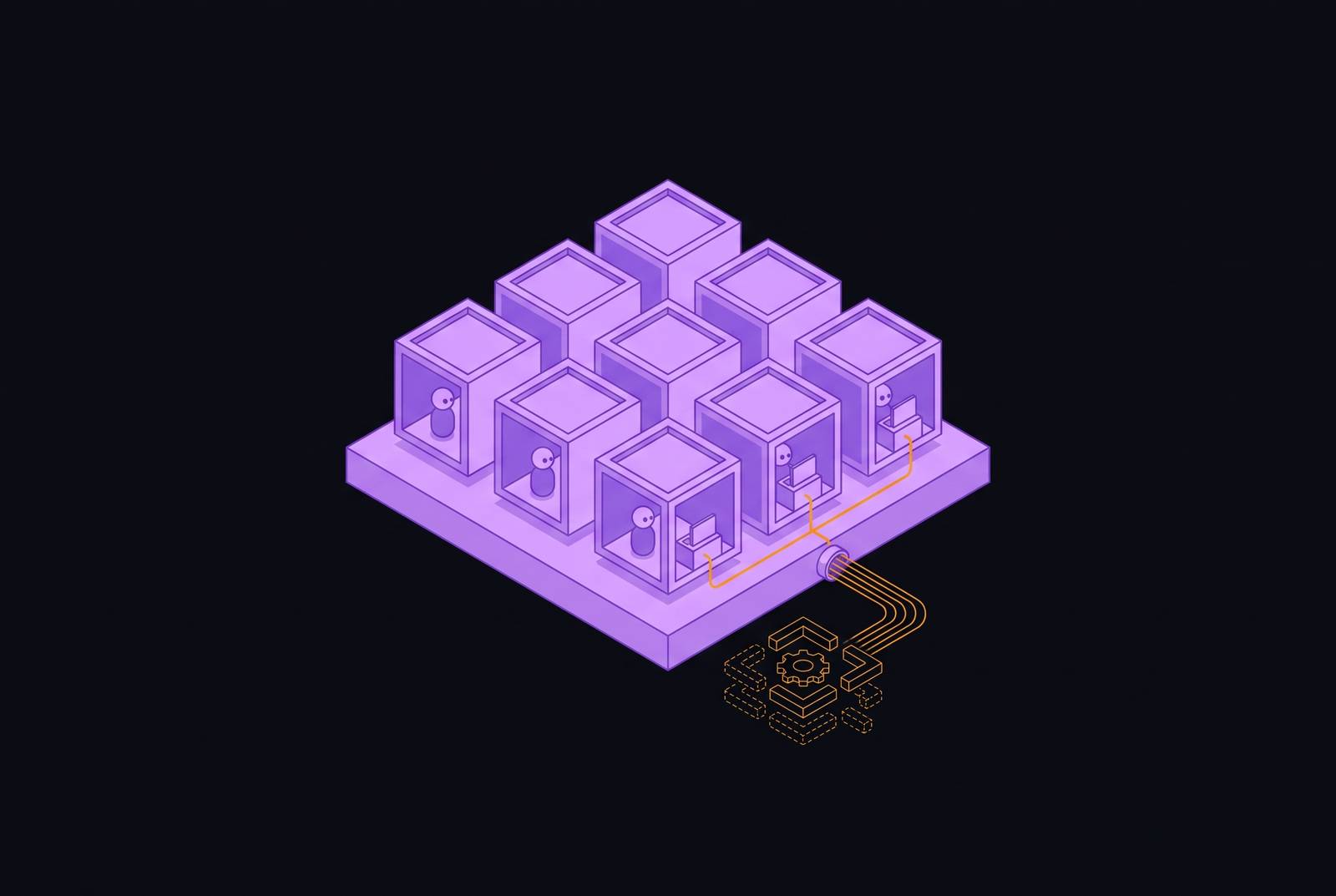
To run Claude Code in the cloud at team scale, use a managed execution environment that gives each agent session its own isolated, pre-configured VM. The architecture saves money when it also stops charging for idle compute, keeps long-term credentials outside the guest, and tracks which work belongs to each session. Those properties remove the infrastructure tax that otherwise accumulates around agentic coding, regardless of the model or harness.
Why agentic coding at team scale has a hidden cost that isn't the model or the harness
An engineering team can get more output from agents without being able to ship more reviewed changes. More concurrent tasks mean more environments to prepare, more dependencies to reconcile, and more machines waiting for model responses or human decisions. A task may finish correctly while leaving the team to pay for idle compute and find time to review another pull request.
These costs form the infrastructure tax on agentic coding. It includes idle compute, secrets embedded in shared environments, drift between sessions, and review overhead that grows faster than output. These costs can grow even with a strong model. When execution depends on a developer’s accumulated local state or a persistent shared machine, each additional agent inherits operational assumptions that the team must maintain.
That operational burden also conceals a security exposure. An agent’s ability to execute commands can extend to deleting files, reading environment variables, or making unauthorized outbound calls without another permissions dialog. Mohammadreza Rashidi’s 2026 execution-security survey examines 39 papers and four disclosed CVEs in production harnesses. The engineering consequence is straightforward. The environment must bound what an agent can do before the team can safely increase how much work it delegates.
What shared and local execution environments actually expose when agents run in them
Local execution gives an agent access to whatever the machine makes reachable. Unrestricted filesystem access can expose SSH keys and.env files, while an erroneous recursive deletion can destroy a critical directory. Database access extends that risk beyond the repository. If the agent has production write access, an unverified SQL statement can irreversibly drop tables.
Johann Rehberger’s ZombAIs demonstration made the execution risk concrete. A prompt-injected Claude navigated to a malicious page, downloaded a binary, and connected to a command-and-control server. The first attempts to download it through bash failed before another way worked. One blocked route did not stop the sequence. The relevant boundary was what the environment ultimately allowed.
Shared containers change the packaging but still share a host kernel. A kernel vulnerability that enables an escape can therefore expose the host, making namespace isolation insufficient for compliance-sensitive multi-tenancy. Concurrent agents also introduce a cross-session exposure. Without an adequate boundary, one session can reach another’s data.
In-editor sandboxes have a documented bypass history. Disclosed attacks have disabled sandbox controls, rewritten MCP configuration before approval, or substituted malicious commands after a one-time approval. These failures concern policy and approval mechanisms. Rashidi’s survey also finds that isolation architectures and capability models are rarely compared on shared benchmarks, limiting the evidence available for choosing among them.
Why hardware-level VM isolation is the boundary that actually holds
A per-session VM gives the agent its own kernel rather than direct access to the host kernel’s system-call interface. This changes the boundary that executed code encounters. Process sandboxes such as Seatbelt and bubblewrap, user-space kernels such as gVisor, microVMs such as Firecracker-class systems, and full VMs address different parts of the threat surface. They are not interchangeable forms of isolation.
Thomas Winninger’s 2026 substrate paper places hardware-isolated VMs together with filtered network egress and an intercepting inference proxy. These controls establish restrictions that a prompt cannot grant or revoke. An agent may disregard a request to avoid a secret, but it cannot read a secret that the environment never makes reachable.
Documented agent-level escapes in 2026 include QEMU/KVM escapes by cyber-capable agents and CVEs affecting Firecracker/KVM deployments. The architectural advantage is a dedicated kernel and a hardware-enforced boundary. Treating the boundary as infallible would obscure the security work it still requires.
Credential placement and network control complete that architecture. OAuth refresh tokens and service account keys must remain outside the sandbox. Outbound access needs its own enforcement as well. Routing guest HTTPS traffic through host-side termination and inspection addresses the exfiltration path that filesystem isolation alone leaves open.
How per-session VM isolation turns a security requirement into an economic model
Per-session VMs, such as those used by Replicas, a cloud coding-agent platform that runs Claude Code, Codex, Cursor or OpenCode in an isolated VM per task and returns a pull request, look expensive when compared only with the cost of keeping a shared machine running. That comparison misses how agents use time. Agents spend much of a session waiting for the model, a user, or a tool, while a persistent machine can remain allocated throughout. Waiting incurs compute costs when it requires active compute.
Checkpointing changes that relationship by allowing the host to suspend an idle microVM and resume it for the next call. The session survives without active resource consumption during the wait. Copy-on-write memory sharing addresses the cost of concurrent execution. Pre-warmed snapshots let microVMs share base operating-system and library pages while keeping each agent’s modified pages private, increasing density without combining session state.
Major cloud providers are converging on per-session microVM isolation as a production model. AWS’s AgentCore Runtime illustrates both the approach and the distinction between CPU and memory charges. Memory use and session lifecycle still change how much the team pays. Google’s per-session isolation offering also shows where the market is heading, though the costs can differ from one implementation to another.
With fast startup, the model works for short tasks. Capsem, an open-source Rust hypervisor for per-session VM isolation, boots a fresh VM to a prompt in under two seconds. A pre-loaded snapshot lets each session start work without first rebuilding its environment. The economic gain therefore comes from the lifecycle around the VM.
What agents actually need the environment to provide to do real engineering work
A secure environment can still be inadequate for engineering. An agent needs dependencies, development tools, browser access, and the ability to start services and inspect their output. The agent needs all of these to fully test its changes. Returning a useful pull request requires, in part, the ability to execute and verify the work.
A properly pre-loaded VM can provide that working environment without exposing the developer’s machine or another agent’s session. It can support package installation, test suites, service processes, and browser-driven integration tests within the session boundary. Isolation permits broader capabilities inside that boundary. It is not a reason to reduce every task to filesystem edits.
Winninger’s paper connects those capabilities to enforceable constraints, including linters, type checkers, and runtime contract validators. Unlike advisory prompts, these tools can reject code that violates the environment’s requirements. The controlled experiment reported backdoor detection recall of 90.9% with the constrained substrate and supporting tools. That result supports the value of an equipped, constrained environment, rather than proving that VM isolation alone improves review.
Ramp’s Inspect agent uses separate ephemeral environments on sandboxed VMs for background coding tasks. Those environments include realistic engineering tools such as Vite, Postgres, and Temporal. The agent needs them to do the work. Pre-configuration also gives each session a known starting state, avoiding the dependency conflicts and accumulated state of a local developer machine while allowing the snapshot to match the team’s toolchain.
How oversight and attribution require the same environmental boundary that isolation provides
Package installations, network calls, file changes, and phase timings can be associated with the agent task that produced them. Isolation alone does not create those records. The execution environment must capture them and preserve their connection to the session, harness, model, and credential.
That connection becomes more valuable as verification constrains throughput. Winninger’s paper identifies the difficulty of auditing thousands of lines of working code before execution, while keeping the codebase legible within reviewers’ context limits. Telemetry from across companies also shows that median code review time rises sharply when AI use is high. More generated output can consume review capacity faster than it produces accepted changes.
The team thus needs measures of the work it ships and the cost of reviewing it. They include 30-day merge rate rather than pull requests opened, median time-to-first-review split by agent authorship, the rate of merges with zero review approvals, and reviewer-hours per merged pull request. Each needs a link the team can trust between execution and output. Otherwise, a team cannot distinguish productive automation from work that merely enlarges its review queue.
Rashidi’s survey shows that execution provenance is often studied as a part of security separate from isolation. Per-session VMs make the two easier to connect by bounding each task’s footprint. Harness choice adds another attribution dimension. A team using Claude Code, Codex, and Opencode needs to compare their model-and-harness combinations by merge rate per reviewer-hour.
What the workflow integration layer requires from the execution environment underneath it
Handing off work through Slack, Linear, GitHub, or another code-hosting platform does not by itself make the execution environment safe. The workflow layer needs the receiving agent to have bounded access, a prepared toolchain, and a verifiable output associated with its session. An integration depends on the execution layer to provide the kernel boundary that makes accepting the task safe before commands begin.
Linear’s June 2026 coding sessions launch illustrates cloud delegation from issue to implementation. Linear Agent reads the issue and discussion, investigates the codebase, proposes an approach, writes code, and opens a pull request using harnesses such as Claude Code or Codex. That workflow demonstrates the experience a managed execution layer must support, with execution environment management handled for the engineer.
Linear’s announcement reports that Ramp built Inspect on its API to connect specifications, customer feedback, and code. Inspect now writes the majority of the pull requests Ramp merges. The same announcement describes Coinbase’s Forge, built on Linear’s Agent SDK and operating across Slack, GitHub, and Linear. Linear reports that Coinbase called it “the place where agents go to get their bearings before starting a task.”
When work runs for a long time, the layer beneath those integrations also needs to manage context. An agent can remember an architecture decision yet edit the wrong file after the repository changes. Knowledge that lasts must be kept separate from live execution state. Stable conventions, approved dependencies, and architectural constraints need a managed context layer, while procedural memory needs version control, explicit update policies, and observability so that an atypical shortcut does not silently become a general rule.
How should a team evaluate running Claude Code in the cloud without managing infrastructure?
An evaluation should begin with the enforcement boundary. Hardware-enforced isolation gives each session its own dedicated kernel, while records show that policy-enforced controls have been bypassed. Neither label substitutes for examining the implementation. The assessment must also establish where credentials reside and how outbound traffic is controlled, because a VM with reachable secrets and unrestricted egress retains those exposures.
Zero CPU billing while waiting is different from zero active resource consumption, and memory charges can preserve part of the infrastructure tax. Checkpointing is the mechanism to examine. Session lifecycle and memory reclamation shape how much the architecture’s potential savings reduce the bill.
Pre-configuration and attribution provide the remaining tests. A snapshot must have the dependencies and tools the team uses so that no one has to prepare it by hand for every run. The platform must also capture session, harness, and model identity so that output can be connected to merge and review outcomes. Harness independence preserves room to change that combination. A managed platform should not make operational convenience depend on committing to one harness.
Winninger’s paper shows how access control, network policies, and strict conventions enforced by tools can work for coding agents as they do for large teams of human engineers. The cloud service earns its place by operating those controls together with session preparation, suspension, and attribution. That is the distinction between outsourcing a machine and removing the work required to run agents on it.