Slack as the Control Plane for Isolated Agent VMs That Ship Pull Requests
Slack channels direct agent requests to isolated VMs that verify code before opening pull requests.
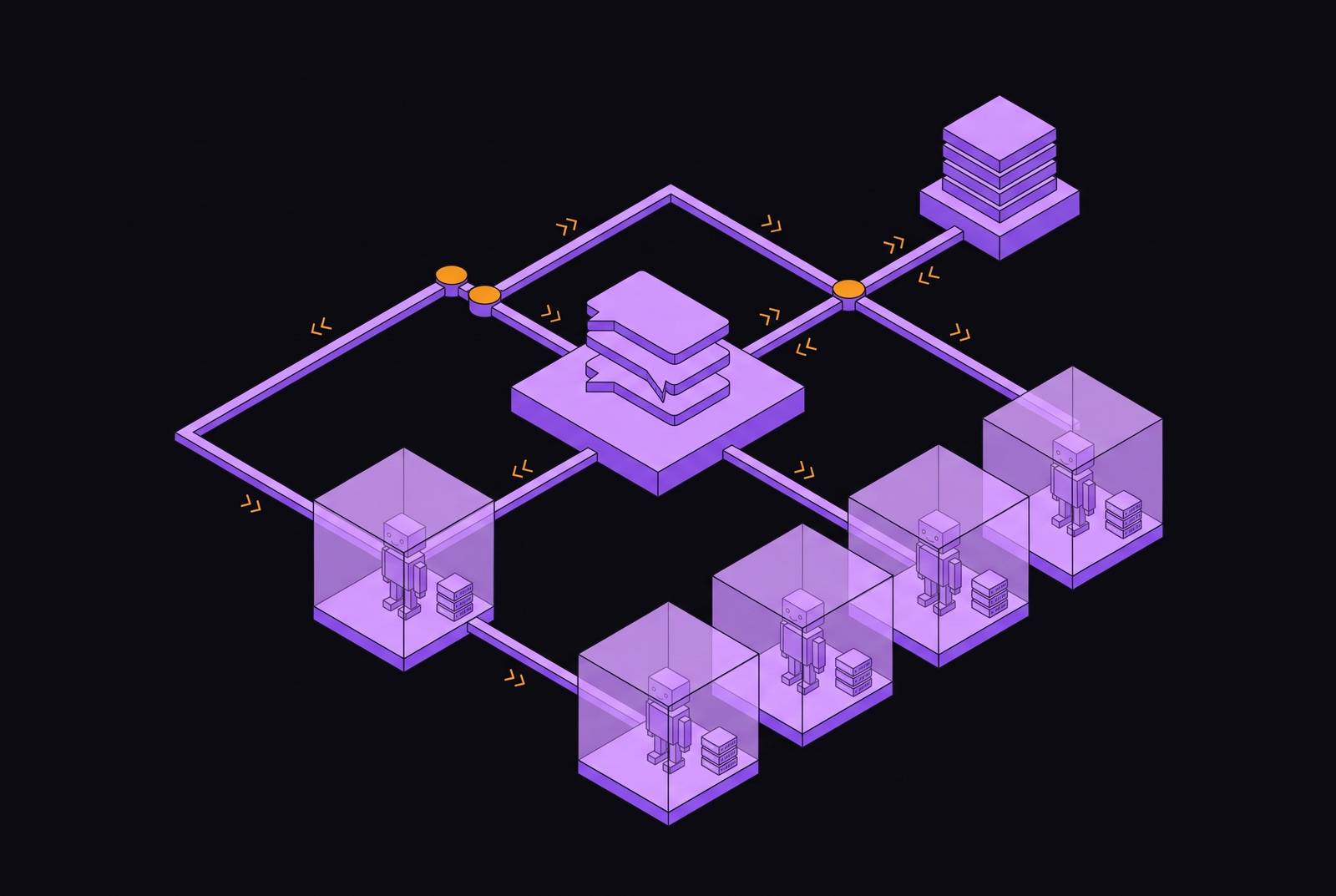
A multi-harness cloud coding agent platform needs two distinct layers to turn Slack requests into reliable pull requests. Slack is the conversational control plane, while an isolated VM gives each task the computer it needs to install dependencies, run services, and check changes. Engineers can trigger Claude Code or Codex from Slack, but the execution environment (not the bot interface) determines whether the result is ready for review.
Why teams who added Slack to their coding-agent setup still don't have a working system
A PM or team lead asks the Slack bot to fix a bug, gets a code change that looks right, and still needs an engineer to finish the job. The engineer copies the suggestion into a repository, installs a dependency, starts the application, and checks whether the fix works. The bot is still acting as a clipboard. It has moved the conversation into a shared channel without moving the work out of someone’s terminal. For the person requesting the change, the apparent automation ends at the point where execution begins.
That gap explains why connecting an agent to Slack does not, by itself, produce a working engineering system. The agent can reason about the request and propose an implementation, but it cannot validate that implementation without somewhere to run it. A conversational answer is not an execution result. If the agent cannot start a test server or check the rendered feature, the engineer still has to find out whether its plan works in the application. The missing component is not another conversational capability, but a computer the agent can use.
What "Slack as control plane" actually means, and what it requires of the execution layer
A control plane is where intent is expressed, decisions are made, and work is steered. It is not where the computation happens. In this arrangement, Slack gives the team a place to request a change, clarify the requirements, and redirect work in progress. The work of installing packages, writing files, running tests against services, and driving a browser happens in a separate execution layer.
Cognition’s Jeff Wang made that distinction explicit while demonstrating Devin in a Slack engineering channel, with work moving to a Slack Code channel. Wang noted that “every time Devin is doing something like this, it does have its own computer”. The demonstration connected the conversation to observable work. The agent used Chrome and DevTools to verify the feature, then posted screenshots and a recorded demo with the PR.
Why the execution environment needs to be an isolated VM, not a container or a shared machine
The execution environment determines both what an agent can attempt and what evidence it can produce. A shared machine has shared state, while standard containers share the host kernel. Neither has the same boundary as a VM. Although containers can install packages and run services, permitting an agent to do so safely requires more than ordinary container isolation. An environment that restricts those operations too tightly also restricts the agent’s ability to test the code under realistic conditions.
MicroVM approaches using Firecracker or Kata Containers give each run its own kernel. Other approaches provide different boundaries and trade-offs. gVisor interposes a user-space kernel, while hardened containers with strict egress controls occupy the lighter end of the isolation spectrum. MicroVMs have become the default for untrusted code in production agent setups, with the agent loop and secrets kept outside the sandbox and outbound access controlled through an allowlist. These boundaries give the task enough freedom to work without giving its code unrestricted access.
That freedom serves correctness as well as security. Inside its own VM, an agent can install dependencies, start the service, and drive a browser before presenting the change for review. Verification becomes part of the run itself. Codex on OpenAI-hosted containers, Claude Code on GitHub-hosted runners, and Cursor on Cursor-hosted VMs can run tests within their sandboxes, but end-to-end verification against live services still requires the team to supply a governed full-stack environment.
Re-cloning a repository and reinstalling dependencies for every task consumes time and money before implementation starts. Stripe addresses setup with pre-warmed EC2 devboxes. Ramp uses Modal filesystem snapshots rebuilt on a regular schedule to avoid repeating repository and dependency setup, while Coinbase built its sandbox in-house. Teams with expensive setup steps should plan persistence explicitly through snapshots or pre-warmed environments.
How do engineers trigger Claude Code or Codex from Slack and get back a pull request automatically?
The sequence starts when an engineer, PM, or designer tags an agent in a channel with a bug report, feature request, or review request. Slack Code, available August 20, 2026, lets the agent create a code channel for each task. The Code API became generally available October 28, 2026. In that channel, the team can follow progress, supply a Figma file, or redirect the task while it runs. Slack’s existing permissions, security policies, and administrative controls apply to agents automatically, so teams can manage the conversational layer with the system they already have.
The next handoff moves the request into execution. The selected harness, such as Claude Code or Codex, takes the task context into an isolated VM and clones the repository or resumes from a snapshot. It installs dependencies and begins the implementation. Because each run has its own environment, one task’s packages do not interfere with another’s. The agent then runs tests, starts the service, and uses a browser where needed to check the feature, while progress returns to the Slack channel.
A Linear-first team can arrange the trigger differently. GitHub Copilot’s Linear integration, generally available July 23, 2026, starts when someone assigns an issue to Copilot. The agent analyzes the issue, works in an ephemeral GitHub Actions environment, opens a draft PR, streams progress to the Linear activity timeline, and requests review when finished. Slack can remain the notification surface in this arrangement. Cyrus offers another Linear-first pattern through an isolated git worktree, Claude Code execution, and updates streamed to Linear, with Codex, Cursor, and Gemini runners also supported. It is open-source, available self-hosted or in the cloud, and uses the team’s model keys, although a worktree alone does not establish VM isolation.
After verification, the agent opens a draft or ready-for-review PR containing the changes and any screenshots or recorded demo produced during the run. The review surface remains GitHub or GitLab. Existing branch protections, CI gates, and approval requirements apply unchanged, so automatic PR creation does not bypass the team’s release process. Human review remains a separate decision before merge. Meanwhile, the Slack channel or Linear thread preserves why the change was requested and who steered it, giving reviewers context that a diff alone cannot provide.
Choosing which agent runs in the VM: how harness and model affect what the workflow can actually do
Once the handoffs are in place, teams can choose the harness and model to fit the workflow instead of taking them as a given in the infrastructure. A complex multi-file refactor calls for different strengths from an inline review assist, so locking every task to one agent trades coverage for convenience. Teams should therefore judge a multi-harness cloud coding agent platform by how it routes tasks as well as how it runs them in isolation.
Artificial Analysis placed Cursor’s Composer 2.5, launched May 18, 2026, third on its Coding Agent Index behind Claude Opus 4.7 in Claude Code and GPT-5.5 in Codex. That ranking helps teams choose, but the choice still depends on the work. Cursor works best for inline pair-programming in the development environment, where teams can use more than one model and have bring-your-own-key support across providers. It is better paired with a cloud agent for delegated tasks than treated as the sole agent. Opencode serves teams seeking provider freedom or local and provider-controlled work, without requiring a proprietary cloud, while a cloud agent handles delegated repository tasks.
For most engineering teams, the practical recommendation is to standardize on two agents. At the cited benchmarks, Claude Code is the natural default for complex multi-file work, while Cursor works for inline flow-state work. Slack can route requests according to task type. This preserves a consistent team interface without forcing all work through the same harness. Teams should also judge a cloud offering by whether it has the isolated execution environment, because support for several harnesses alone still leaves them with infrastructure to manage.
The review bottleneck that appears once the workflow actually works
When agents reliably produce verified PRs, the throughput constraint shifts from generation to human review. More completed runs can mean more waiting changes. A team that adds more tasks without checking how much reviewers can take on can shift its queue from work waiting to be done to work waiting for approval. The execution layer has done its job, but the change still has to pass through a person’s attention.
The practical response is to design three controls into the workflow from the start. Teams should limit how many agent tasks are open at once, route PRs automatically to the right reviewer, and use the channel’s audit trail to give reviewers the context they need. Reviewers should not need to reconstruct the run. Slack Code’s per-task channel can expose the plan, live diffs, and recorded demo, showing what the agent attempted, what it verified, and why the work took its final form.
Attribution then makes the queue easier to diagnose. Every run should be traceable to its source, harness, model, credential, and duration. Those dimensions connect review outcomes to the work that produced them. They let the team distinguish task types that merge quickly from those that repeatedly accumulate in review. Routing can then respond to the actual pattern rather than treating every generated PR as an equal contribution.
What to instrument and measure so the system improves over time
Operating this workflow requires a record that connects the initial request to the final PR outcome. The minimum useful instrumentation includes per-run attribution to the agent, model, credential, Slack trigger, and VM. It also includes task-to-PR conversion rate, which shows how often a triggered task leads to a PR that goes into review. PR creation is only an intermediate result. Merge rate, review wait time, and revision cycles by task type show what happens after the agent hands over its work.
If agent-generated PRs wait significantly longer than unassisted PRs, the review bottleneck is already present. Task volume should be throttled until routing or reviewer capacity is adjusted. A harness that consistently produces high-merge-rate PRs for dependency updates, test coverage gaps, or documentation should become the default route for that class of work, while low-merge-rate tasks need better scoping or human co-authorship before execution.
Slack Code archives each code channel when its job is done, preserving the agent’s work, the team’s discussion, and the resulting changes in a searchable record. Along with measurements of the results, it helps teams get better over time at choosing tasks, routing them to a harness, and planning how much work reviewers can take on. The compounding value is more PRs that merge, less engineer time spent on triage, and more leverage from the agents already running.