Wiring Claude Code and Codex Into Your Engineering Team's Daily Workflow via Managed Cloud Agents
Set up cloud agents in Slack, Linear, and GitHub for seamless code delegation.
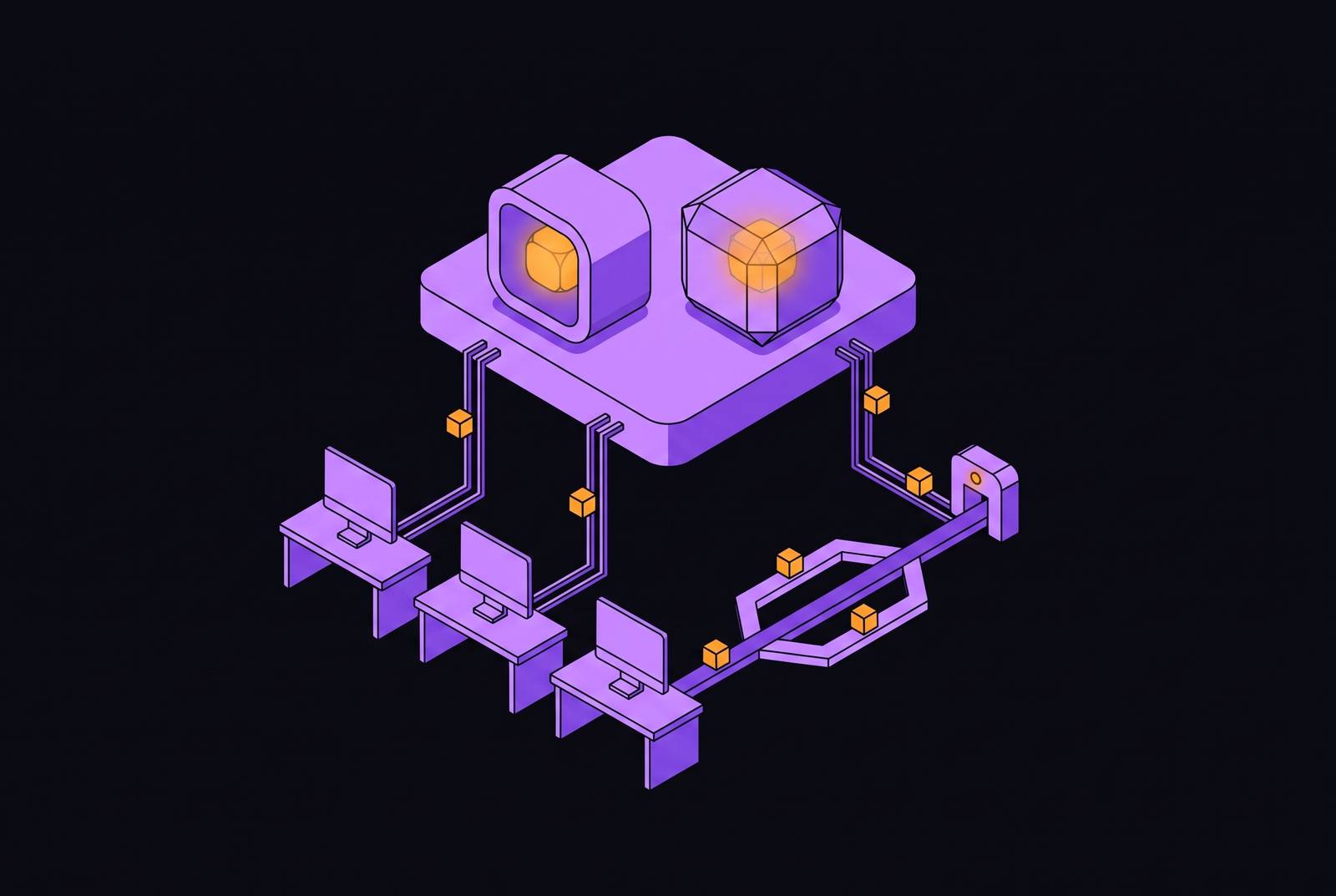
To run Claude Code in the cloud, use a managed sandbox for execution, connect task assignment to Slack, Linear, or GitHub, and route the resulting pull request through a human review gate. The same workflow applies to Codex. Wiring these agents into an engineering team’s daily work is an integration challenge because reliable delegation depends on shared context, working environments, and clear handoffs.
Why 2026 is when cloud agent workflows, not just tools, became the real adoption challenge
The defining shift in 2026 is from asking for coding assistance to delegating background work. The Stack Overflow Developer Survey found that AI coding tools are widely used, but barely half of professional developers use them every day. That gap separates access from routine use. A tool can be available to every engineer without becoming part of how the team assigns, reviews, and ships work.
Both Claude Code and Codex support parallel background work with approval controls, so an engineer no longer needs to supervise every step in an editor. The intended handoff is concrete. A ticket gets assigned, an agent runs in a cloud environment, and a pull request appears. Those steps still need to connect to the team’s existing operating rhythm.
What Claude Code and Codex actually do when they run as background cloud agents
Codex cloud mode provisions an isolated container preloaded with the repository. The agent reads files, edits code, runs commands and tests, and returns diffs for review. Tasks can run in parallel without blocking the editor. OpenAI’s system card says that network access is disabled by default, which lowers supply-chain risk while the agent runs. The container is the agent’s working environment, rather than an extension of the engineer’s active editor session.
Claude Code Agent Teams coordinates multiple Claude instances working in parallel on a shared codebase. The feature is experimental in v2.1.32+ and is enabled through CLAUDE_CODE_EXPERIMENTAL_AGENT_TEAMS=1. Each teammate has its own isolated 1M-token context window, and peer-to-peer mailbox messaging lets teammates talk to each other beyond a lead-and-worker hierarchy. Coordination is distinct from execution. Claude Code runs each session’s model-and-tool loop, and the environment around it handles repository setup and checks the work.
In both cases, engineers inspect artifacts. Those artifacts can include a diff, pull request, or recording. This suits work that can proceed without constant interaction, including codebase-wide audits, migrations, test generation, and refactors. This also helps with security audits when findings need to be checked independently. The execution model makes the reviewable result the handoff point.
How Claude Code and Codex compare as tools for team-wide delegation
Claude Code fits reasoning-intensive review and coordinated work. Its review capabilities cover logic errors, performance, security, and style, with extended thinking supporting detailed analysis. Agent Teams and Dynamic Workflows address complex, hours-long tasks, while native GitHub Actions and GitLab CI/CD integrations support headless execution. Benchmarks describe a different dimension of performance. They measure performance on individual tasks.
Codex emphasizes governance and deployment flexibility. Gartner’s Magic Quadrant for Enterprise AI Coding Agents in May 2026 recognized its strengths in agentic software development, enterprise governance, sandboxing, and flexible deployment. Codex provides approval gates, RBAC, customizable policies, and OS-level sandboxing, with access through an app, IDE extensions, CLI, SDKs, and cloud orchestration. Those controls still depend on the deployment surface. They should not be assumed to cover every API or CLI cost-control requirement.
OpenCode has a permissive license and lets the team choose its provider, but it has no proprietary cloud infrastructure, so the team handles governance. Cursor remains editor-first, with an agent window and CLI added to that foundation. SpaceX acquired Cursor in an all-stock deal that closed August 14, 2026, placing its CLI in the same company as xAI and Grok. That ownership is a long-term dependency consideration, not a performance verdict. The practical pattern is to use the IDE for everyday shipping, Claude Code for difficult reasoning and review, and Codex where its governance and assignment surfaces fit, while keeping the workflow independent of any one harness.
Why agents fail at the team level without persistent shared context
A new agent session does not automatically inherit the team’s understanding of the codebase. Without that context, it can misread conventions or change an intentional design. Model quality cannot supply an undocumented architectural decision. Claude Code uses CLAUDE.md and Codex uses AGENTS.md to keep instructions from one session to the next. These files give repeated runs a common basis for decisions.
A team’s context file should name the tech stack and dependency versions, including the ORM, and describe code style and naming rules that linters do not enforce. Architecture decisions explain why the code is built the way it is. Testing instructions define coverage expectations, frameworks, and how to run the suite. The PR workflow belongs there too, with rules for naming branches, checks that must pass, and what commit messages should include. Explicit boundaries identify configuration files, migrations, generated code, or other areas that agents must not modify without instruction.
With Agent Teams, each spawned teammate automatically loads the same CLAUDE.md. When .claude/settings.json hooks are committed, every developer gets the same guardrails, and a shared prompt library helps keep their approaches from drifting apart. As the repository changes, old instructions can lead agents to make more and more wrong decisions.
Connecting agents to where engineering work actually starts: Slack, Linear, and GitHub
A designer posts a broken-layout screenshot in #bugs, and a teammate tags Codex to fix the header alignment in the frontend repository. Codex’s native Slack integration can return a PR link to that thread within minutes. The conversation stays where the problem was reported. App installation and account setup are prerequisites, but the working pattern does not require the engineer to open a terminal. Delegation becomes part of the existing discussion.
Linear provides another assignment path. An issue can be assigned to Codex like a teammate, with progress appearing in the Activity feed. Claude’s Linear connector lets a session read and write Linear, but the connector itself does not trigger tasks. Linear’s June 2026 changelog adds a separate capability. Linear Agent can use Claude Code and Codex to write code as part of the issue workflow.
GitHub and GitLab connect assignment to repository events through Claude Code’s official GitHub Action and GitLab-maintained beta CI/CD integration. MCP extends context across those surfaces. A single MCP-backed prompt can read a Linear ticket, inspect a related Sentry issue, find a Slack discussion, create a GitHub branch, and update a Notion launch document. The value is continuity across the handoff. Work is assigned as it would be to a human teammate, and the PR, comment, or status update returns to the relevant conversation.
How to run Claude Code in the cloud reliably at team scale
A sandbox that cannot install packages, run services, or execute tests is not functionally equivalent to a developer machine. UI tasks may also need to be checked in a browser. Long-running tasks need a way to pick up where they left off after an interruption, and Dynamic Workflows makes this possible by saving state as they run. An agent needs these capabilities to verify its work before returning a PR.
Isolation and persistence solve different problems. Codex isolates cloud tasks in containers, while its local CLI applies OS-level restrictions and Claude Code on Linux uses bubblewrap. For custom harnesses, Fly.io Sprites provides 100GB of persistent storage per sandbox and checkpoint/restore in around 300ms, fitting long-running tasks. Daytona moved to a private codebase in June 2026 and is managed-cloud-only, so it is not a self-hosted option. With managed execution, the team no longer owns the infrastructure, but it still has to configure the environment.
Governance is a production concern at this layer. Codex’s API/CLI path lacks native governance, per-developer budget enforcement in the CLI, and outage fallback, despite the Enterprise-tier admin console added in June 2026. The recommended pattern is a centralized AI gateway with per-developer token budgets and per-team rate limits. Parallel editing also needs explicit isolation. Claude Code sessions can use separate git worktrees with their own branches, adding .claude/worktrees/ to .gitignore and using .worktreeinclude to copy required gitignored configuration into new worktrees.
The CI/CD integration pattern that moves agents from helper to gatekeeper
Running claude -p or codex exec on pull requests places agents directly in the review pipeline. Claude Code supports this through its GitHub Actions and GitLab CI/CD integrations. The agent can check changes, write tests, update documentation, and make routine fixes before a human reviews the work. Its output is a structured artifact. Engineers can continue other work while the pipeline produces a diff, test file, or review comment.
The human gate is part of the design. All agent output should pass through it before merging, and the pipeline should enforce this requirement. Codex provides approval gates and RBAC. Claude Code Agent Teams supports plan approval, keeping a teammate read-only until the lead accepts its implementation plan. TaskCreated, TaskCompleted, and TeammateIdle hooks provide defined checkpoints for quality controls, but agent plan approval is not a substitute for human merge approval.
Background execution does not imply full autonomy. Anthropic’s internal data reports more merged PRs per engineer per day with agent use, while the share of fully delegated tasks remains low. The engineer stays involved, with more of the work spent checking results and making decisions.
Managing agent teams at scale: token cost, task decomposition, and avoiding coordination overhead
Agent Teams, subagents, and Dynamic Workflows serve different coordination needs. Agent Teams fits parallel workers that must exchange findings, such as security and test reviewers challenging each other before a lead synthesizes the result. Subagents fit workers that only need to return results to a caller. A tightly scoped task may need only one session. Dynamic Workflows fits orchestration that should be encoded as repeatable JavaScript.
More workers do not guarantee more useful work. The operational guidance is to start with two to three agents and expand progressively, because coordination overhead can exceed productivity gains beyond five. Tasks with heavy sequential dependencies offer little benefit from parallel execution. Workers running in parallel also need to know which files each owns, because teammates who edit the same file can overwrite each other. Worktrees isolate working directories, but the changes still need compatible task boundaries to fit together.
Verification is another limit on expansion. Monolithic architecture and weak test coverage obstruct reliable Agent Teams use because work is difficult to separate or check. Both Agent Teams and Dynamic Workflows consume substantially more tokens than a single session, so smaller, well-scoped tasks provide a basis for calibrating consumption before broad rollout. Fountain, a frontline workforce platform, provides a concrete example beyond coding workflows, using hierarchical multi-agent orchestration to cut screening time in half and compress a week-plus staffing cycle to days, while substantially reducing onboarding time for new fulfillment centers.
Measuring what agents actually shipped: attribution, analytics, and steady-state adoption
A completed run is not the same as shipped work. Teams need to link agent runs to merged PRs, work out which kinds of tasks agents do reliably and which are better left to humans, and compare the cost per developer with how much more work gets done. Run-level attribution provides the foundation. It should identify the source, harness, model, credential, and duration, with the result connected to what merged. Without that connection, activity can be mistaken for value.
Adoption also needs to be examined over time. Cohort and task-type tracking can distinguish a useful steady state from disengagement after an initial surge. A team may delegate less frequently because it has found the right boundaries, or because the workflow remains unreliable.
Anthropic’s internal data adds another dimension by identifying a significant share of agent-completed work as new work that would not otherwise have been done. Measurement therefore needs to consider both scope and speed. Faster delivery of an existing backlog and the ability to undertake previously neglected work are different gains. Attribution dashboards make those gains visible within the same operating discipline as context maintenance, sandbox configuration, and review controls. The test of managed cloud agents is not how often they run, but whether their work reliably reaches the team’s shipping process.