Task Taxonomy for Teams Running Claude Code Codex Cursor and OpenCode Side by Side
Four agents serve different coding tasks—refactors, cloud PRs, editor work, and model choice.
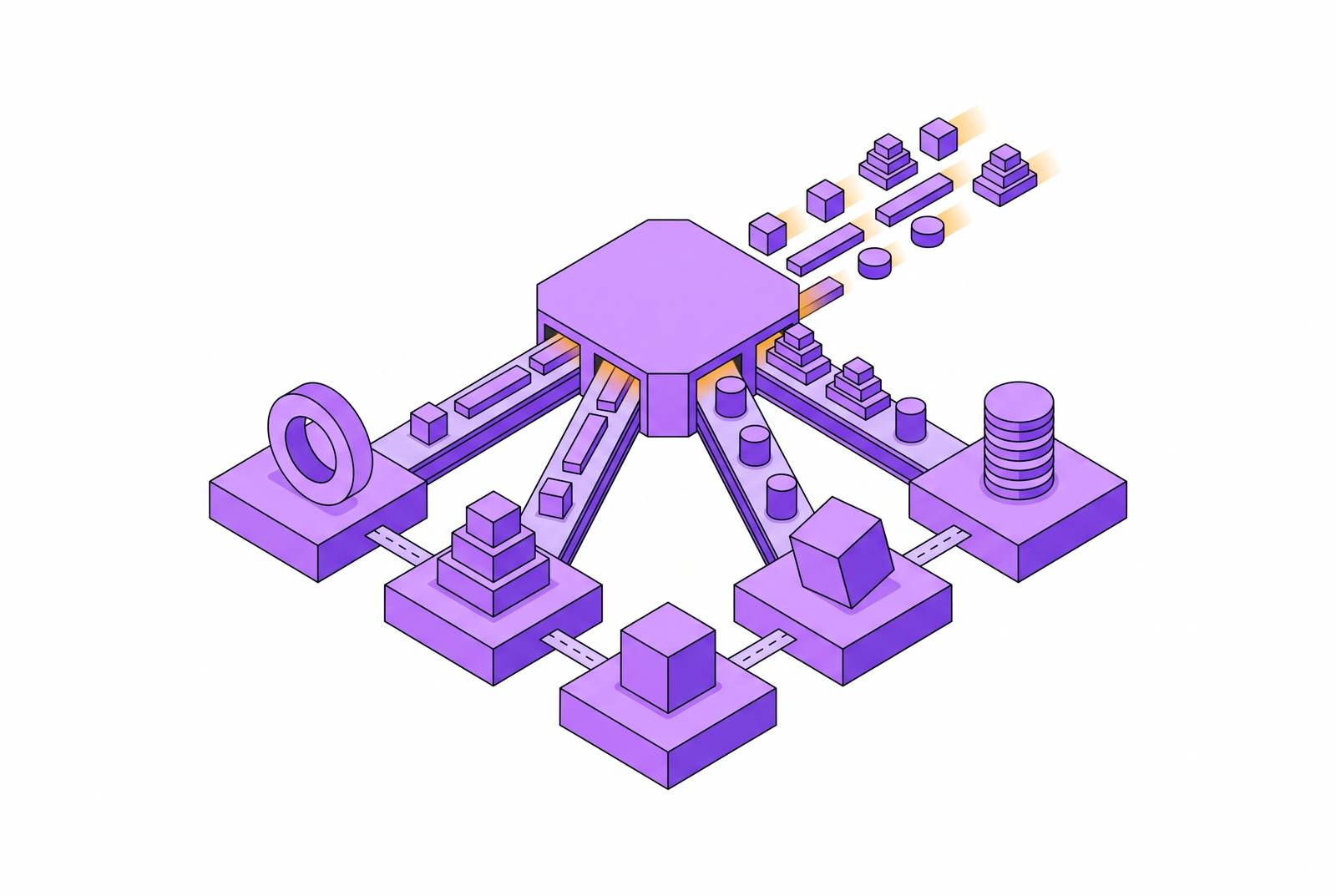
A task taxonomy for teams running Claude Code, Codex, Cursor, and Opencode side by side should route work by task demands. Claude Code fits sustained refactors, Codex fits cloud issue-to-PR delegation, Cursor fits editor-native iteration, and Opencode fits model choice and harness ownership. A multi-harness cloud coding agent platform should make those routes available through shared workflows, isolated environments, and human pull-request review.
Why teams running multiple agents need a routing framework, not a "best agent" verdict
The four agents increasingly share the same feature list, including subagents, hooks, MCP, and parallel runs in Git worktrees. By 2026, using them together is a normal team configuration. Codex and Claude Code can both run as extensions inside Cursor, so even the interface no longer cleanly separates them. Capability lists alone offer little routing guidance.
Without explicit routing logic, the same task can land in different tools depending on the engineer who starts it, producing inconsistent results and wasted spend. The useful distinctions are where the work runs, which models are available, how tokens are priced, and how much of the stack the team owns. A model release can overturn a “best agent” verdict. A routing framework lasts longer because its criteria come from the work.
What actually separates the four agents: surface, model lock, and token economics
Claude Code is CLI-first, with terminal, VS Code, JetBrains, desktop, web, and mobile surfaces. Its default on paid plans is Claude Opus 5.5 with a large context window. Native model choice is limited to Anthropic models. Bedrock, Vertex AI, and Foundry are supported through official environment variables, while third-party gateways can route to non-Claude models. Its agent tooling includes agent view, /goal mode, dynamic workflows, hooks, skills, and a plugin marketplace.
OpenAI Codex centers on sandboxed cloud execution, where it can install dependencies, run tests, and open pull requests without using a local machine. OpenAI also provides a CLI, an IDE extension, and native GitHub integration. The cloud is not its only surface. Codex is bundled into ChatGPT Plus at a monthly subscription price, although heavy cloud use may require additional credits. Plugins and goal mode joined its tooling in 2026.
Cursor is a VS Code fork built around editor interaction, with an Agents Window, Tab completion, and visual diffs. It subsidizes its own models within a weekly pool and passes third-party model costs through. BYOK support separates the editor from the model provider, and Cursor can read Claude Code’s skills and hooks directly. Its plan lineup changed shortly before the October 2026 comparison, making current allowances a purchasing consideration.
Opencode is an MIT-licensed, model-agnostic harness supporting 75+ LLM inference providers, with teams paying for model tokens and using the harness free of charge. Its client/server architecture uses the same engine for its terminal, desktop, and IDE surfaces. Model choice belongs to the team throughout. The harness has a tool loop, session management, Language Server Protocol integration, and worktree tools for agents that run in parallel. It can also run fully offline through Ollama or LM Studio with a tool-calling-capable local model.
Task type one: Long autonomous multi-file work and complex refactors
A long autonomous refactor requires the agent to understand interdependent files before changing them. An early mistake can propagate through the work. Renaming an interface across dozens of modules, changing a service boundary, or migrating a data model across the stack all have this shape. Their difficulty is not simply the number of edits but the need to preserve a coherent plan as those edits accumulate. Claude Code has the clearest structural fit for this task.
Its large context window lets it read and keep codebase context, while /goal mode keeps working until a separate model checks that the stated condition has been met. Completion is not limited to a single pass. Dynamic workflows let Claude write scripts coordinating dozens or hundreds of subagents for large migrations. Agent view then exposes background sessions on one screen, each in its own Git worktree.
The alternatives remain relevant under different constraints. Codex fits defined patterns, while Cursor is better suited to bounded changes than long sessions requiring sustained planning. Opencode with a high-capability model can handle the same broad task shape when model freedom or cost control takes priority. The routing distinction is therefore the combination of planning demands and native orchestration.
Task type two: Issue-to-PR delegation and cloud-native background jobs
A background delegation task begins with enough specification for the agent to proceed independently, such as a GitHub issue, a failing test, or a written spec. The task should produce a reviewable pull request. Codex fits this route because its sandbox can install dependencies, run tests, commit changes, and open a PR without occupying the developer’s local environment. Its GitHub integration connects the issue to that execution path. Multiple tasks can be queued for parallel background work.
Stripe’s Minions illustrates this Codex task shape at scale using a fork of Block’s Goose harness. Stripe reports approximately 1,300 pull requests per week with no human assistance beyond code review. During its internal Atlas Fix-It Week, agents reproduced issues, wrote fixes, ran tests, and submitted PRs for a substantial share of bugs. A human still had to review the work before it went to production. Each run used an isolated devbox pre-warmed with code and services, with no access to the internet or production, so it could run without asking humans for permission.
Commercial isolated-cloud agents offer a route to the same review-gated pattern without reproducing Stripe’s full internal platform. Linear is another place to delegate work, though its integrations work differently. Its Cursor integration opens a PR and posts the link back, while its Codex integration posts a cloud-task link where a reviewer can create a PR or continue working. The human assignee remains primary when an agent contributes. Code-ownership rules can assign the reviewer, and delayed review can be flagged on the engineering manager’s dashboard.
Task type three: In-editor iteration and targeted in-codebase changes
A focused refactor, endpoint addition, component edit, or new test often begins while the developer is already navigating the relevant code. Cursor fits changes bounded to one or a few files because the developer can inspect the result without moving into a separate working surface. Existing extensions, keybindings, and editor workflows carry over. Visual diffs, Tab completion, and the Agents Window help developers check and accept changes over and over as this work requires.
Model choice does not have to change that surface. BYOK support lets teams use Claude Opus 5.5 or GPT-5.5 as the backbone, while shared Claude Code skills and hooks help editor work and autonomous work follow the same conventions. That continuity does not eliminate the visibility tradeoff. Cursor’s agent mode shows less of what it is doing than a CLI does, so it is harder to tell what went wrong when a long session goes off course. Heavy usage can also reach “fast request” limits and push teams toward API-based pricing.
The practical recommendation is to keep Cursor focused on work whose scope and diff remain easy to inspect. When correction prompts accumulate or the file set expands unexpectedly, the task has begun to outgrow the original routing decision. That is a signal to reconsider the route. Teams should also verify current plan allowances before committing, because subscription labels alone do not establish the economics of their intended workload.
Task type four: Model-switching, offline work, and cost-controlled automation
Some tasks cannot send prompts outside the team’s infrastructure because of data residency, audit requirements, or codebase sensitivity. Other tasks need a change of model without a change of workflow. Opencode fits these conditions through local-model support and ownership of the harness itself. A tool-calling-capable model that runs through Ollama or LM Studio can do the work fully offline. Its MIT license makes the stack auditable and self-hostable, rather than tying these requirements to a hosted agent’s available settings.
The Language Server Protocol feedback loop is another structural distinction. The agent reads file contents and uses compiler and linter diagnostics as feedback, which is useful when automation has limited human oversight. The same engine can serve automated and interactive work. Its client/server architecture works across terminal, desktop, and IDE surfaces, and teams can choose from 75+ providers to change models without replacing the harness. Opencode is therefore a harness-ownership destination as well as a lower-cost substitute for Claude Code.
Opencode’s lack of markup on normal API rates makes it a stronger fit when teams run a lot of automated work. Credentials still require explicit planning, however. Anthropic blocked Opencode’s OAuth flow for Claude Pro/Max subscriptions in January 2026, so Claude models used through Opencode require a direct API key.
Where task types overlap and how to handle the gray zones
A medium-complexity bug may call for cloud delegation or a long investigation. The deciding test is the scope of the explanation. With a failing test and known root cause, a task framed as identifying the relevant function and proposing the smallest fix fits Codex. If understanding the failure requires reading many interdependent files, the route shifts toward Claude Code.
For long autonomous work, teams face a different choice between Claude Code and Opencode. Teams needing Claude Code’s /goal mode, plugin marketplace, or dynamic workflow scripting have no equivalent in Opencode today. Teams needing to swap models mid-project or keep prompts off Anthropic’s infrastructure have a stronger reason to choose Opencode. The relevant constraint is not whether both can attempt the work, but which requirement cannot be traded away.
An expanding Cursor refactor has a similarly testable boundary. More than a handful of correction prompts, or more touched files than the developer expected, signals a restart as Claude Code or Codex delegation. Shared tooling makes mixed routing more practical. All four agents support Model Context Protocol, allowing shared context and tools on the same project without manual handoff. That interoperability supports escalation without requiring every task to start in the heaviest autonomous workflow.
Running the routing framework as a team practice, not an individual choice
To make these routes consistent across a team, the lesson is to encode them in workflows and agent configuration. Stripe’s rule files show how instructions for a codebase help agents keep their work in line with human conventions across runs. The taxonomy can extend those instructions. Teams can specify which tasks proceed autonomously, which require escalation, and which must be flagged for human review. Linear triage policies can then assign the appropriate agent by task type while preserving human ownership.
Slack-triggered delegation makes routing available from a shared communication surface alongside a CLI. Stripe’s emoji-to-PR pattern demonstrates the interaction, but it does not establish an automatic Claude Code or Codex integration. For teams asking how to trigger either agent from Slack and receive a PR, the criteria are the supported harnesses, the trigger integration, isolated execution, and the actual PR-creation behavior. A cloud-task link and an automatically opened PR are different outcomes.
Attribution down to source, harness, model, and credential lets teams compare what each route produced and what merged. Review and testing become the downstream constraint as generation accelerates. Teams can use that attribution to check whether complex-refactor PRs from Claude Code merge more successfully than similar Codex work and test whether they assigned the work correctly in the first place.
Environment parity is the prerequisite for a meaningful comparison. A Claude Code session unable to install dependencies or run services cannot be expected to outperform a Codex cloud run that can. Sandboxed, pre-loaded environments that allow package installation, services, browser use, and verification make the routing claims operational. For a multi-harness cloud coding agent platform, supporting several agents is only the entry requirement. Giving each route the environment and review path it needs is the purchasing test.